Poker game guide

Omaha Calculator

Open the Omaha calculator

What the game is

Omaha gives each player four private cards. Players must use exactly two private cards and exactly three board cards.

Rules of Omaha

  • Each player starts with four private cards, also called hole cards.
  • Five community cards can be dealt like Hold'em, but Omaha hand construction is stricter.
  • For every final hand, Omaha requires exactly two private cards and exactly three community cards. You cannot use one, three, or four private cards.
  • The best five-card high hand wins the pot.

Example calculations

  • Enter A♠ A♥ K♠ Q♥ against J♠ T♠ 9♥ 8♥ on Q♠ 7♦ 2♣ to compare top set, redraws, and wrap pressure.
  • Enter a wrap draw and a made set on the flop to see how many turn and river cards matter.
  • Use dead cards to model exposed blockers in live-game study.

Strategy examples

  • Omaha equities run closer than Hold'em, so compare strong-looking hands before overvaluing them.
  • Study blockers because having key suits or straight cards can change draw value.
  • Use board-specific calculations to separate nut draws from dominated draws.

Calculator preview

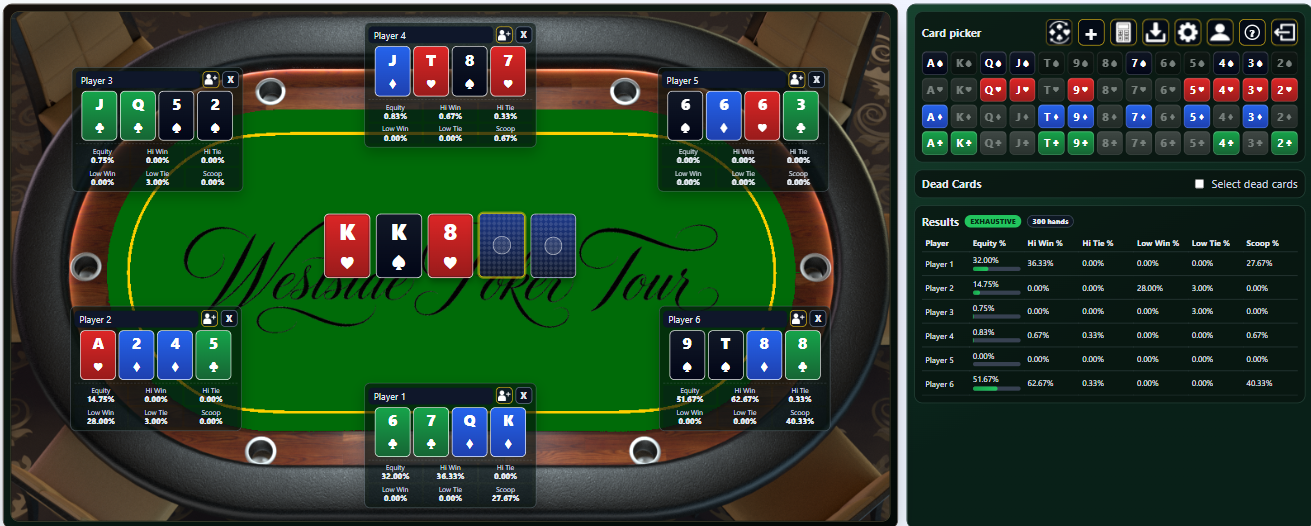
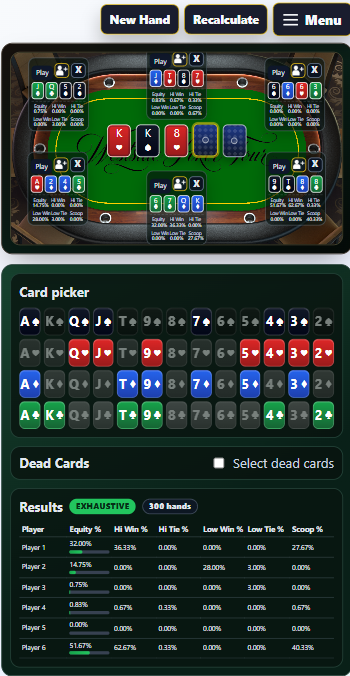
Preview the Omaha calculator

The Omaha calculator link opens the full table view with Omaha already selected, so you can move from the rules on this page straight into a real hand study.

Use it to enter the same kind of cards shown in the examples, adjust known board cards or dead cards when they matter, and see how each card changes the numbers.

The results help you compare equity, ties, and how much the next card can change the shape of the hand.

Clicking through is the fastest way to preview the real Omaha calculator workflow before you start building your own examples.
Preview the Omaha calculator

Screenshots

Omaha calculator desktop table view Omaha calculator mobile table view

Omaha FAQs

Does the calculator enforce Omaha hand construction?

Yes. Omaha calculations use the exactly-two-private-cards and exactly-three-community-cards rule.

Can I study PLO draws?

Yes. Add flop or turn cards and compare made hands, wraps, flush draws, and blocker-heavy hands.