Hand equity
See how often a hand is expected to win against another hand, a group of hands, or several opponents. Equity helps you understand whether you are ahead, behind, or close enough to continue.
Poker equity study tools
Study hands, understand equity, and make better poker decisions with a visual poker calculator built for Hold'em, Omaha, Hi-Lo, Stud, Razz, and mixed games. Compare real hand matchups, explore different runouts, review draws and blockers, and see how high-only, low-only, and split-pot equities change as each new card appears.
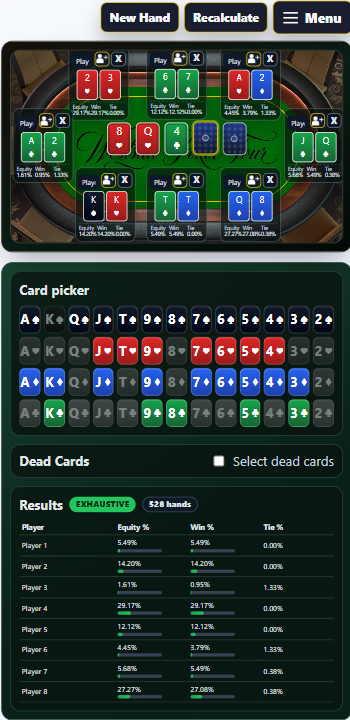
Poker decisions are easier to understand when you can see the math behind them. Use the calculator to study common spots, compare starting hands, review runouts, and understand how each new card changes your equity.
See how often a hand is expected to win against another hand, a group of hands, or several opponents. Equity helps you understand whether you are ahead, behind, or close enough to continue.
Study flush draws, straight draws, full house redraws, combo draws, and low draws in Hi-Lo games so you can learn which draws are worth chasing.
Compare starting hands in Hold'em, Omaha, Big O, Stud, Razz, Pineapple, and other variants where raw hand strength can be less obvious than it first appears.
Test paired boards, monotone boards, low-card boards, coordinated straight boards, and split-pot boards to see which cards help or hurt your hand.
Equity changes fast when more players are involved. Study heads-up, three-way, four-way, and family-pot scenarios before relying on instincts alone.
Review scoop equity, nut-low draws, backup low cards, high-only hands, low-only hands, and spots where a weak low can get quartered.
Translate equity into an easier winning-percentage view so you can see how often a hand should win, tie, or lose over many similar runouts.
Use equity as the math side of a pot-odds review. Compare your chance to win or improve with the price you were offered, then decide whether the call made sense away from the table.
Compare your hand against other specific hands to learn domination, blockers, redraws, and why a hand that looks strong heads-up can shrink in value multi-way.
The calculator gives you numbers, but the value comes from learning how those numbers connect to poker decisions.
If a hand has 65% equity, it is expected to win about 65 out of 100 similar situations over time. That helps separate good decisions from short-term results.
Compare your chance to improve against the bet size, pot size, and whether your draw is likely to be good when it hits.
Many mistakes begin before the flop or on early streets. Compare hands to learn which holdings have nut potential, domination risk, or poor multiway equity.
After a session, enter key hands and ask whether you were ahead, had enough equity to call, overvalued a draw, or missed a better line.
Run the same hand on the flop, turn, and river to see how one card can change equity, drawing odds, and the best review question for the hand.
Check when a hand that performs well heads-up loses value against three or more players because more draws, blockers, and made hands are live.
In Omaha Hi-Lo, Big O, Big Easy, Pineapple Hi-Lo, and Stud Hi-Lo, study when a hand can scoop, when it is mostly playing for half, and when it risks being quartered.
Use the calculator as an off-table study and hand-review tool, and follow the rules of the sites, rooms, and jurisdictions where you play.
The goal is not to memorize every number. The goal is to build better instincts by studying enough situations that the math starts to feel natural.
A calculator gives you an objective way to review hands, especially after emotional hands, bad beats, big pots, or close calls.
Use repeated study to spot patterns like overplaying one-pair hands, chasing weak draws, misreading Omaha blockers, or playing weak lows in split-pot games.
Studying common spots away from the table helps you recognize equity, draws, risk, and long-term expectation more quickly during play.
Mixed games often punish Hold'em-only intuition. Use the calculator to study Omaha, Big O, Stud Hi/Lo, Razz, and other games with less familiar hand values.
Repeated comparison helps you recognize hands with nut potential, coordinated cards, live lows, redraws, and fewer domination problems.
Studying odds and equity makes it easier to separate a tempting draw from a draw that needs a better price or stronger implied value.
Post-session review gives bad beats, coolers, and big calls a mathematical frame, so one result does not distort your next decision.
Different players can use the same poker calculator in different ways. Start with the basics, then add more complex equity questions as your game grows.
Learn outs, odds, winning percentage, hand strength, and why the best-looking hand before the flop can change quickly after the board appears.
Review hands after sessions, find leaks, compare close calls, and learn which draws or made hands lose value in tougher spots.
Analyze blockers, multi-way pots, split-pot pressure, Stud dead cards, Razz lows, Big O scoop potential, and variant-specific strategy questions.
These terms appear throughout hand review. Clear definitions make the calculator results easier to apply to real poker decisions.
Equity is your share of the pot in the long run if the same situation were dealt many times. A hand with 40% equity will still lose often, but the number shows its long-term expectation.
Outs are unseen cards that can improve your hand. Some outs are clean, while others can make a second-best hand or complete an opponent's draw.
Board texture describes how connected, paired, suited, high, low, or draw-heavy the community cards are. Texture changes which hands and draws are credible.
In split-pot games, a scoop means winning both the high and low halves of the pot. Studying scoop potential is often more useful than studying high equity alone.
Enter a hand, choose a game, add board or dead cards when they matter, and study the odds. Better poker starts with better review, and better review starts with real numbers. Create a registered account for faster calculations, or upgrade to Pro when you want the fastest calculation tier and more room for randomized trials in complex spots.
Texas Hold'em gives each player two private cards and up to five shared community cards. The best five-card hand wins at showdown.
Read the Hold'em guideOmaha gives each player four private cards. Players must use exactly two private cards and exactly three board cards.
Read the Omaha guideOmaha Hi/Lo is a split-pot Omaha game where the best high hand can split with the best qualifying eight-or-better low hand.
Read the Omaha Hi/Lo guidePineapple starts each player with three private cards and uses Hold'em-style community cards for the final hand evaluation.
Read the Pineapple guidePineapple Hi/Lo combines three-card Pineapple starting hands with split-pot high and qualifying low outcomes.
Read the Pineapple Hi/Lo guideTahoe is a three-card community-card poker game often played high-low split, where the best high hand can share the pot with the best qualifying low hand.
Read the Tahoe guide5-Card Omaha gives each player five private cards and uses exactly two of them with three board cards.
Read the 5-Card Omaha guide6-Card Omaha gives each player six private cards and still uses exactly two with three board cards.
Read the 6-Card Omaha guideComing soon
7-Card Omaha is a high-only Omaha variant where each player receives seven private cards and still builds the final hand using exactly two private cards with exactly three community cards.
Read the 7-Card Omaha guideComing soon
7-Card Omaha Hi/Lo is a split-pot Omaha variant where each player receives seven private cards and competes for the best high hand and the best qualifying eight-or-better low hand.
Read the 7-Card Omaha Hi/Lo guideBig O is five-card Omaha Hi/Lo. Players receive five private cards and compete for high and qualifying low halves of the pot.
Read the Big O guideBig Easy is a six-card Omaha Hi/Lo style variant with large starting hands and split-pot outcomes.
Read the Big Easy guideComing soon
Double Board Variants are bomb pot and split-board poker games where players see two boards at once, then compete for board-specific high hands, ultimate high and low outcomes, or other room-defined split-pot formats.
Read the Double Board Variants guideComing soon
Draw Games are poker variants where players receive private cards, decide which cards to keep, discard the rest, and draw replacements to improve a high hand or make the best qualifying lowball hand.
Read the Draw Games guideSeven Card Stud has no shared board. Players build the best five-card hand from their own seven-card hand, with visible up cards and hidden down cards.
Read the Stud guideSeven Card Stud Hi/Lo is a split-pot stud game where high and qualifying low hands can divide the pot.
Read the Stud Hi/Lo guideRazz is a lowball stud variant. The goal is to make the best low hand, with no high-hand half of the pot.
Read the Razz guide